

European Bachelor in Infrastructure and Transitions

The European Bachelor in Infrastructure and Transitions will open in September 2027. Accreditation is underway with the Commission des titres d’ingénieur (CTI), France’s engineering accreditation body, for the Grade de Licence (French state recognition at bachelor’s level) and the European Degree Label. This three-year programme, taught in English, is open to students who have completed upper-secondary education (French Baccalauréat or equivalent). It combines strong scientific foundations, civil engineering, sustainable infrastructure and digital tools, with an integrated study pathway in France and Spain, as well as an optional semester in Türkiye.
Designed jointly by École nationale des ponts et chaussées (ENPC) and Universidad Politécnica de Madrid (UPM), with İstanbul Teknik Üniversitesi (ITÜ) as mobility partner, the programme pairs academic rigour with a European, multi-campus learning experience.
The European Bachelor at a glance
3 YEARS · 180 ECTS | JOINT DEGREE | TAUGHT IN ENGLISH |
FRANCE + SPAIN | ISTANBUL OPTION | 40–60 STUDENTS |
A Bachelor built for tomorrow’s challenges
Tomorrow’s infrastructure will have to do more with less: adapt to climate change, use fewer resources and serve societies in transition. The curriculum is built around this challenge, preparing students to combine scientific rigour with a clear understanding of what to build, for whom, and why. To meet this ambition, the programme rests on four complementary pillars:
- Strong Scientific Foundations: mathematics, physics, mechanics, materials and engineering sciences.
- Civil Engineering for Infrastructure: structures, water, transport, energy networks and materials, with sustainability and resilience embedded throughout.
- Digital Technologies and Data: scientific computing, data, BIM, modelling and introductory machine learning.
- Projects and Professional Skills: case studies, practical work, capstone projects (modelling, prototyping, research), professional immersion (4 weeks), final internship (22 weeks) and Bachelor Thesis.
Three prestigious institutions
The programme brings together three historic engineering institutions, all founding members of the EELISA European University alliance. The Bachelor builds on this cooperation through joint academic design, integrated mobility and a shared approach to engineering education.
- École nationale des ponts et chaussées (ENPC) - France, degree-awarding institution: founded in 1747, one of the world’s oldest engineering schools, with recognised strengths in civil engineering, applied mathematics and environmental transition.
- Universidad Politécnica de Madrid (UPM) - Spain, degree-awarding institution: one of Spain’s leading technical universities, whose School of Civil Engineering dates back to 1802, renowned for structures, water, transport and sustainable infrastructure.
- İstanbul Teknik Üniversitesi (ITÜ) - Türkiye, mobility partner: founded in 1773, Türkiye’s oldest technical university and a major centre of engineering at the crossroads of Europe and Asia.
A European journey
Up to three countries in three years, with every period abroad fully integrated into the degree.
Years 1 and 2 - ENPC and optional ITÜ mobility
During the first three semesters in Champs-sur-Marne, near Paris, students build their scientific and technical foundations. The curriculum eases the transition from secondary school to higher education through structured study methods, progressive independence and first applications in civil engineering.
In Semester 4, students can stay at ENPC or spend the semester at ITÜ in Istanbul, subject to academic requirements and available places.
Year 3 - UPM and worldwide professional experience
In Semester 5 in Madrid, students broaden their knowledge of infrastructure and choose technical options to shape their own profile.
Semester 6 is devoted to the final internship and Bachelor Thesis, in a company or research laboratory, in France, Spain or anywhere in the world.
This programme is designed for students completing secondary education who:
- have a strong interest in mathematics, physics and engineering;
- are curious about the infrastructure behind mobility, water, energy, construction and territorial development;
- want to understand how engineering can respond to ecological, energy and digital transitions;
- want to study in English in an international, multi-campus environment;
- enjoy learning through projects, teamwork and open-ended problems.
Entry expectations
No prior knowledge of French or Spanish is required for entry. Language courses are integrated into the curriculum.
Admission is selective. Applicants are expected to have:
- an upper-secondary qualification* giving access to undergraduate studies in the country where it was awarded;
- a strong academic record in mathematics and physics;
- English at B2 level*, certified as specified for each admissions campaign;
- the ability to work with rigour and growing independence.
* Applicants who do not yet hold their upper-secondary qualification or English certificate at the time of application may still apply, provided they submit them upon admission.
How to apply
Applicants use one route only, depending on their education system:
- French secondary education system: apply through Parcoursup.
- Applicants from the Spanish education system:
- Step 1: apply through our online application platform (opening soon);
- Step 2: apply through the Distrito Único de Madrid, in accordance with UPM admission rules.
- Applicants from other education systems: apply through our online application platform (opening soon).
Further details will be published soon. Leave your contact details to receive the brochure and be the first to hear when applications open.
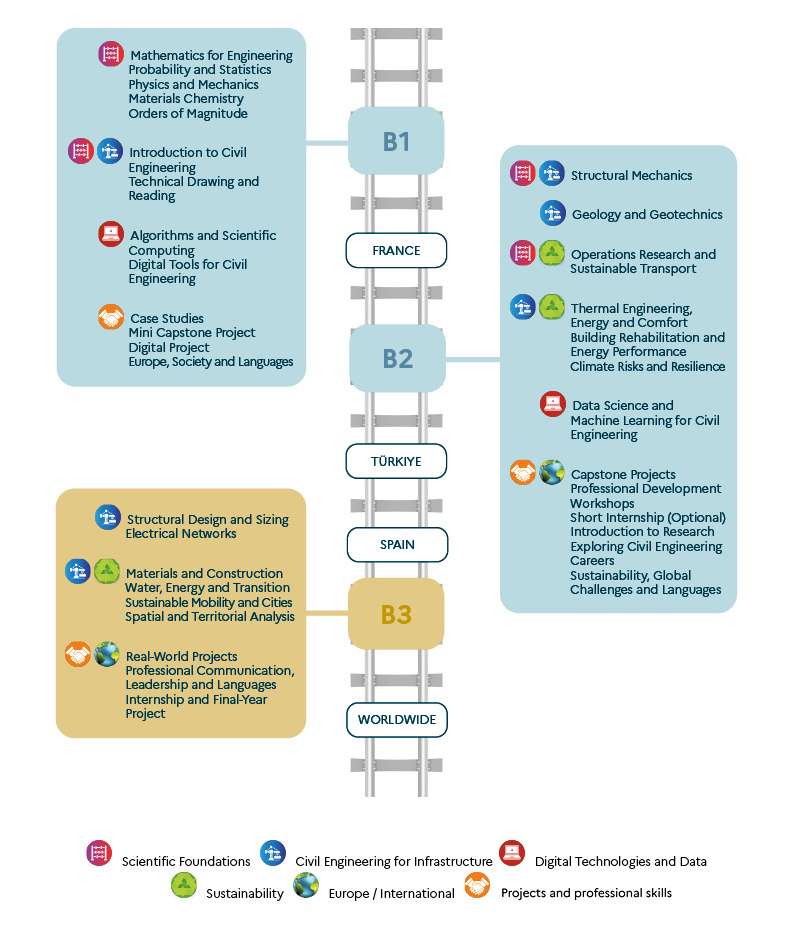
The curriculum progresses from scientific foundations to core civil engineering, then to specific infrastructure fields (structures, energy networks, water, mobility and cities), applied projects and professional integration.
Projects throughout the programme
Project-based learning is structured progressively through a Mini Capstone Project, Capstone Project 1 and a research-oriented Capstone Project 2. Students work individually and in teams to frame problems, test assumptions, use digital tools, communicate technical reasoning and connect knowledge from several disciplines.
The Bachelor is designed to open two pathways: progression to further study or entry into professional roles at Bachelor level.
Continue to postgraduate study
Graduates can apply to Master’s programmes, engineering degree programmes or other advanced qualifications in France, Spain, elsewhere in Europe or internationally. Compatibility with a specific programme may depend on the student’s individual module choices, academic record and the prerequisites of the target programme. Admission to further study remains subject to each institution’s own prerequisites, selection criteria and formal procedures.
Enter professional life
The programme prepares graduates for technical and project-support roles in civil engineering and infrastructure, particularly in engineering consultancies, construction companies, infrastructure operators, project management support and related organisations.
Typical fields
- Construction, structures, geotechnics and materials
- Transport infrastructure and mobility
- Water infrastructure
- Energy and electrical systems
- Digital engineering and BIM
Examples of entry-level positions
- Engineering assistant / junior project engineer
- Junior project assistant in a design office
- Assistant site manager
- Junior BIM modeller
- Junior consultant in infrastructure or sustainability consultant
Contact the programme team
+33 (0)6 08 97 92 12