

2nd EELISA PhD Symposium brings together 150 doctoral researchers in Paris
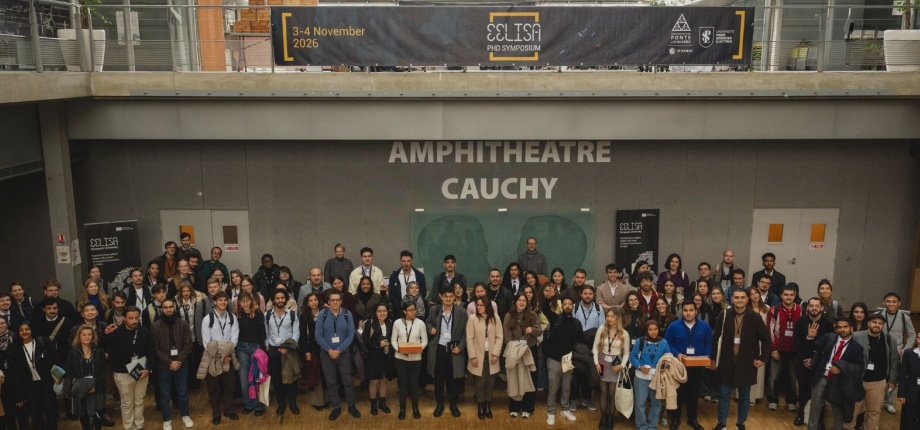
On 3 and 4 November 2026, the School and Université PSL hosted the second edition of the EELISA PhD Symposium in Paris. Bringing together 150 registered participants from 10 higher education institutions across eight countries, the event provided doctoral researchers from across the EELISA European University Alliance with a unique opportunity to exchange ideas, develop new skills and explore the role of innovation in their research journey.
The symposium took place at the School on 3 November and continued at Université PSL on the morning of 4 November. Over the two days, participants took part in keynote sessions, interactive workshops and discussions designed to encourage interdisciplinary exchange and strengthen connections within the EELISA research community.
A strong European research community
The second edition brought together participants from Budapest University of Technology and Economics (BME), École nationale des ponts et chaussées (ENPC), Friedrich-Alexander-Universität Erlangen-Nürnberg (FAU), Istanbul Technical University (ITU), Politehnica University of Bucharest (UPB), Scuola Normale Superiore (SNS), Scuola Superiore Sant’Anna (SSSA), Universidad Politécnica de Madrid (UPM), Université Paris Sciences et Lettres (PSL), and Zurich University of Applied Sciences (ZHAW).
This broad representation reflected the European dimension of the symposium and its ambition to create a shared space in which doctoral researchers can connect beyond institutional and disciplinary boundaries.
Unlike the previous edition, this year’s programme did not include a poster session. Instead, the focus was placed on interactive formats, discussions and workshops, giving participants more opportunities to exchange directly with speakers, experts and fellow researchers.
Innovation at the heart of the doctoral journey
The symposium explored innovation as an integral part of research, encouraging doctoral candidates to consider how their work can generate scientific, societal and economic impact.
Throughout the programme, participants addressed topics including intellectual property, inclusive innovation, value proposition design, open science and public speaking. These sessions provided practical tools and new perspectives to help young researchers better communicate, protect and enhance the value of their work.
As Anita Kumari, Innovation, Entrepreneurship and International Projects Manager, explained:
The EELISA PhD Symposium is more than an opportunity for young researchers to exchange knowledge and ideas; it is a space to inspire them to think beyond the boundaries of their disciplines and see themselves not only as researchers, but also as potential innovators. By connecting PhD students from across Europe and introducing them to new perspectives, tools and approaches to innovation, we aim to empower a generation of researchers who can turn scientific knowledge into meaningful impact and contribute to addressing society's challenges.
Rethinking objectivity and invisible bias in research
One of the highlights of the symposium was the panel discussion “Rethinking Objectivity: How Invisible Bias Shapes Research and Innovation”, moderated by Anita Kumari and Anca Mihalache from Université PSL.
The session invited participants to question assumptions and examine how unconscious or invisible bias can influence research and innovation environments. By addressing these issues with doctoral candidates at an early stage of their academic careers, the panel highlighted the importance of creating research ecosystems in which a greater diversity of ideas and perspectives can be heard and valued.
The discussion was particularly relevant in connection with the closing programme of the EELISA PhD Mentorship Program, held on 2 November, whose mission is to support individuals who are particularly marginalised in academia.
Reflecting on the session, Anita Kumari noted:
The panel on ‘Rethinking Objectivity: How Invisible Bias Shapes Research and Innovation’ was a great way to bring different perspectives on innovation to students across the Alliance. The discussion focused on challenging assumptions and identifying bias within research and innovation environments, which is especially important to bring attention to when addressing doctoral candidates early in their careers. [...] It was a reminder that innovation is not only about the ideas we develop, but also about whose ideas are heard, valued and given the opportunity to make an impact.
Building lasting connections across EELISA
Beyond the workshops and discussions, the symposium offered participants an opportunity to meet peers from across Europe, discover common research interests and create new professional and scientific connections.
For Mustafa Sevimli, European University Project Manager, the success of this second edition confirms the growing role of the symposium within the Alliance:
We are incredibly proud to have successfully held the second edition of the EELISA PhD Symposium, which has now become one of EELISA’s flagship events. This symposium reflects our shared commitment to fostering interdisciplinary collaboration, connecting young researchers across Europe, and creating a vibrant space for exchanging ideas, knowledge, and experiences. It is also a celebration of EELISA's growing network of talented researchers.
He added that EELISA aims to continue building on this momentum and supporting the next generation of researchers in addressing current and future societal challenges.
By jointly hosting the second EELISA PhD Symposium, the School and Université PSL reaffirmed their commitment to European scientific cooperation, interdisciplinary research and innovation.
With 150 registered participants from 10 institutions and eight countries, this second edition demonstrated the strength of EELISA’s growing doctoral community and its shared ambition to turn scientific knowledge into meaningful impact.