

European electricity system planning for 2050: a serious game - 2nd edition
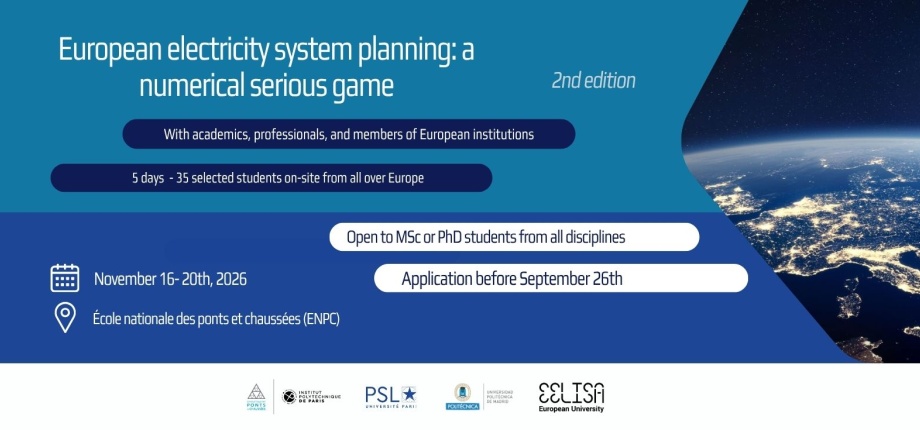
This activity offers a multidisciplinary team-based learning experience focused on one of the major challenges facing Europe: designing a resilient, efficient, and carbon-neutral electricity system for the decades ahead.
Over five days, participants will attend lectures delivered by experts from academia, industry, and European institutions, while also engaging in extensive hands-on activities. A significant part of the programme will be dedicated to a serious game based on numerical simulations of future European electricity system scenarios. These simulations will be conducted using a dedicated PyPSA-based platform relying on data from the European Resource Adequacy Assessment (ERA).
The objective of the programme is to introduce students to the key questions, concepts, models, mathematical methods, and computational tools used in electricity system planning. Through the serious game, participants will take part in a collective decision-making process at the European level. Each team will represent a specific country and will be responsible for defining its investment strategy: what generation capacities should be developed between 2035 and 2050? What level of cross-border interconnection should be established to enable cooperation and resource sharing with neighbouring countries?
The theoretical sessions will provide participants with the foundations required to address these challenges, including:
• designing future electricity demand scenarios based on national characteristics
• formulating electricity supply planning as a cost-minimisation optimisation problem (Unit Commitment)
• balancing model accuracy with computational complexity
• integrating climate change considerations into long-term energy planning
The practical sessions will allow students to implement their strategic investment decisions, simulate the operation of the European electricity system, and analyse the outcomes collectively. Through discussions, negotiations, and collaboration with other teams, participants will assess and improve the overall performance of the system. They will also face numerical stress tests designed to reveal the challenges and vulnerabilities that future electricity systems may encounter.
Further Reading
• A detailed description of the programme is available here and on EELISA digital campus page
• Participants are encouraged to explore the European Resource Adequacy Assessment (ERA), a flagship study supporting long-term planning of the European electricity system. The 2024 edition and its Executive Report provide valuable insights into current planning approaches
• For the French case, RTE’s Energy Pathways 2050 study offers an example of how long-term electricity system planning is conducted at national scale. Idem, you can find the Executive summary here.
• Students interested in the mathematical and techno-economic foundations of the programme may also consult introductory resources on the Unit Commitment Problem.
Credentials
Upon successful completion of the activity, all participants will receive EELISA credentials recognising the achievement of Level 3 in the following Sustainable Development Goals (SDGs):
• SDG 7 – Affordable and Clean Energy
• SDG 13 – Climate Action
• SDG 17 – Partnerships for the Goals
Participants will also produce either a position paper or a poster presenting the outcomes of their work.
Participation and Funding
• Registration and participation are free of charge
• A dedicated budget is available to support travel to Paris and accommodation costs for a limited number of students from institutions located outside the Paris and Île-de-France region
• Students who are not eligible for this funding are encouraged to contact their local EELISA coordinator (ELO) to explore alternative support opportunities
Application and Selection Process
• The organising team will make a final selection based on the quality of the application, the motivation expressed by candidates, and the information provided
• As the programme relies heavily on discussions, collaboration, and negotiations between student teams, diversity of backgrounds will be strongly valued, including nationality, academic discipline, gender, and educational experience, in order to foster a wide range of perspectives
• Applications demonstrating a commitment to low-carbon travel will also be viewed favourably. Subject to budget availability, additional financial support may be provided for train travel
Required Documents
• Resume
• Motivation Letter
Applicants may wish to address the following questions in their motivation letter
• What is your academic and personal background?
• Have you gained any experience in the energy sector or in power system planning?
• What would your ideal future European electricity system look like?