

EELISA Podcast: Engineering the Transition, European-Style
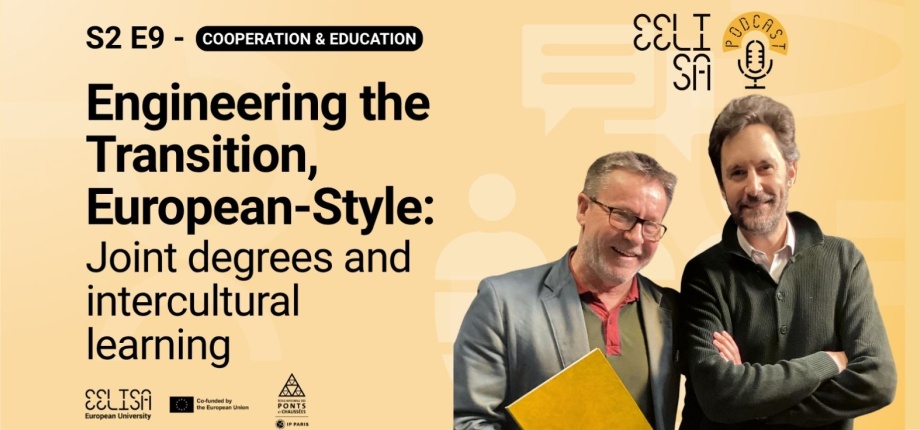
This podcast series aims to give a voice to members of the EELISA community (academic staff, institutional leaders, and students) by engaging them in discussions on major societal and academic issues, with a particular focus on the role of European higher education in addressing contemporary challenges.
In this episode, Thibaut Skrzypek, involved in joint education and recognition within EELISA, and Steve Brown, Head of the Department of Languages and Cultures, share their perspectives on the theme: "How European engineering approaches the transition."
In a context shaped by climate uncertainty, increasingly complex infrastructure systems, and highly interconnected societies, how should Europe educate its future engineers? As the ability to navigate complexity becomes essential, the ninth episode of season two of the EELISA podcast explores what it truly means to "engineer the transition" in a European context.
Universities and the ecological transition: what are we really training for?
In the face of ecological transition challenges, universities are not mere observers. They play a central role in shaping the knowledge of future generations of professionals, conducting research, and developing innovative solutions to sustainability issues. But will tomorrow’s engineers be capable of rebuilding, adapting, and protecting society?
For Thibaut Skrzypek, the ecological transition fundamentally reshapes how engineers must approach their profession.
The ecological transition is not simply a "new topic" to be added to curricula, it profoundly changes how engineering decisions must be made.
Today’s engineers must operate within a complex set of constraints: carbon, resources, biodiversity, resilience, and social acceptance. In this context, engineering education must prepare students not only to design systems, but also to make informed decisions that integrate technical, environmental, geopolitical, and social dimensions.
As Steve Brown emphasizes, transitions are not only technical, they are human. There is therefore a growing awareness of the essential role of the humanities in engineering education. Engineers will work across borders and cultures, so they must be equipped with the tools to better adapt, observe, and listen.
Why joint degrees matter for Europe
Joint degrees are the result of structured cooperation between higher education institutions. They offer students the opportunity to deepen their specialization, gain international experience, and develop unique interdisciplinary profiles.
They also enable universities to design programmes based on shared curricula, learning outcomes, and academic responsibilities. In this way, they contribute to building a more integrated European Higher Education Area.
Joint degrees are a way to build a genuine European education ecosystem, not only through mobility, but also through shared programmes, learning objectives, values, and quality assurance mechanisms.
These initiatives can take different forms: fully integrated programmes designed collaboratively from the outset, or the gradual integration of European components into existing degrees, allowing more students to benefit from international learning experiences.
From a cultural perspective, they also shape how students perceive their education.
For Steve Brown, joint degrees provide a valuable opportunity to discover how different cultures approach engineering. It means learning within multiple academic cultures and accessing different ways of thinking, debating, and working. Students must be ready to open up and be receptive to others, while host students must also be willing to welcome those coming from outside.
Educating engineers to address transitions goes beyond technical excellence. It requires European cooperation, shared learning pathways, and the ability to work across cultures and disciplines. Joint degrees and collaborative initiatives offer a concrete way to build this shared space, one in which students learn across multiple academic traditions while tackling common societal challenges.