

The School has adopted a mission statement and published its SD&SR master plan
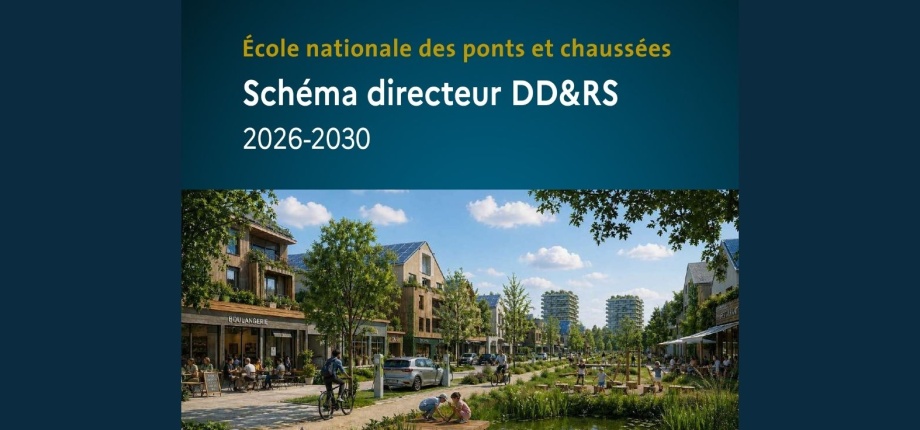
Faced with the scale of the socio-environmental challenges of the 21st century, engineering professions and higher education institutions alike are called upon to adapt their practices, methods and objectives. The transformations required are far-reaching and challenge the way we think and act in a world characterised by increasing complexity.
Driven by this conviction, the School has adopted a mission statement that serves as the guiding principle for its strategy and gives meaning to an approach that aims to combine scientific excellence, regional transformation and a response to major socio-environmental challenges.
We develop, integrate, transform and pass on the sciences and techniques of engineering, the social, environmental and digital sciences, so that, together, we can envision, build and transform regions and their communities, enabling current and future generations to participate in economic and civic life, to find housing, to receive an education, to enrich their lives and to empower themselves, whilst remaining healthy, supportive and inclusive, and respecting planetary boundaries.
A SD&SR master plan for a comprehensive approach to transformation
In order to put this mission into practice, the School has drawn up, discussed and adopted its Sustainable Development and Social Responsibility (SD&SR) master plan.
Download the SD&SR report (in French)
Based on the SD&SR framework developed by CIRSES, this master plan sets out a structured approach centred on the key aspects of a higher education and research institution’s responsibilities:
- training those driving change;
- developing responsible research;
- fostering thriving communities;
- strengthening the institution’s environmental exemplarity;
- generating positive societal impacts at various levels.
This approach reflects the School’s unique positioning, with its teaching and research activities contributing directly to changes in regions, infrastructure, production systems and ways of life.
Energy transition, resource efficiency in regions, the evolution of networks, new materials, the circularity of buildings and infrastructure, the transformation of production systems and the governance of transitions: these are all areas in which the School aims to help meet society’s needs whilst taking planetary boundaries into account.
A collective approach
The drafting of the mission statement and the development of the master plan involved all stakeholders within the School and its wider community: students, administrative staff, researchers, and industrial and academic partners.
This collective engagement is one of the strengths of the initiative. It reflects the commitment to building a shared strategy and making SD&RS a cross-cutting priority at the heart of the School’s operations and missions.
The SD&RS master plan thus constitutes, alongside the School’s quality assurance framework, a central tool for steering its activities.
Its publication marks a new stage: that of the practical implementation of this strategy and the collective pursuit of the School’s socio-ecological transformation.