

The School reaches out to the public for Industry Week at the Cité des sciences et de l’industrie
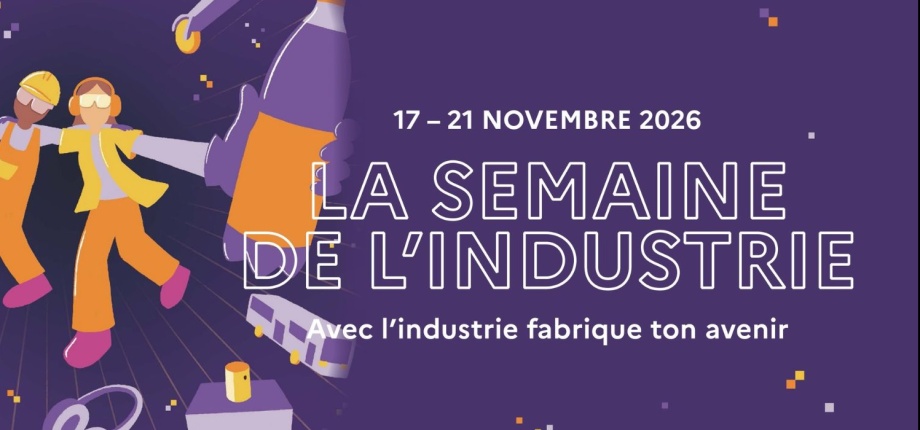
From Thursday 19 to Saturday 21 November, the School is taking part in Industry Week at the Cité des sciences et de l’industrie. It will be offering a programme of science outreach focusing on innovation, eco-design and the reuse of materials, designed for the whole family and schoolchildren.
Researchers, research engineers, architects, PhD students, science communicators and pupils will be on hand to share their work and pass on their passion for science through workshops that invite visitors to experiment, get hands-on and understand.
By combining demonstrations, hands-on activities and direct discussions with scientists, the School aims to make cutting-edge research accessible, spark curiosity and give everyone the tools to better understand the innovations that are transforming industry and the construction and mobility sectors.
Programme
The Ecological Emergency Pavilion (main hall of the Cité des sciences et de l’industrie)
Engineering and architecture students from the School’s Department of Civil Engineering and Construction, in collaboration with researchers from the Navier Laboratory, will be organising a number of activities centred around a temporary pavilion, modelled on a ready-to-assemble emergency structure (5m x 5m, 3m high), which illustrates the research work of Aymeric Manté, an architect and PhD student working with Holcim. Its live construction is supported by Würth France and Holcim.
In emergency situations, the solutions currently in place for providing accommodation remain inadequate in the long term, as reconstruction takes between 5 and 10 years. The project involves designing and optimising accommodation solutions in the form of multifunctional spaces that can be rapidly assembled and dismantled, at a limited cost. The aim is to build sustainable temporary accommodation quickly, at least partly through self-build, making maximum use of local resources. Both the installed pavilion and the proposed outreach workshops will provide an insight into how these modules are designed, in terms of both materials and construction processes.
The supervisors and students will present the pavilion’s design process, the research and technical choices that led to its creation, as well as the construction methods employed.
Science outreach workshops linked to the Pavilion
This demonstration will be complemented by outreach workshops designed to inspire future careers and raise awareness of design engineering in a world of finite resources.
Thursday 19 November
- Workshop 1: Distorting shapes! dForms: how do you combine two two-dimensional shapes to create a three-dimensional form?
- Workshop 2: Bridge Challenge: Crossing the Île-de-France region, or how to build scale models of bridges inspired by the types found in the Île-de-France region
- Workshop 3: The structural fold, or how to understand the structural benefits of the fold by working with paper models
Friday 20 November
- Workshop 1: Hands in plaster! Or how a thin layer of plaster can become a solid structure
- Workshop 2: Made of concrete, but not unbreakable! The brittleness and reinforcement of concrete: a demonstration using bending tests
Saturday 21 November
- Workshop 1: Inflated origami! Or how to transform a flat membrane into a three-dimensional shell simply by inflating it
- Workshop 2: Vacuum-sealed and it holds! Or how a vacuum can transform a bundle of bamboo into a rigid, curved structure
- Workshop 3: Inflated, but not floppy! Or how to transform a flexible inflatable structure into a rigid one
Véli: prototype of a light electric commercial vehicle (on the first floor of the Village de l’Industrie)
The School will be presenting a prototype of a light electric utility vehicle. Designed to transport materials and equipment on the School’s site, this versatile vehicle can carry up to two pallets and is suitable for use both indoors and outdoors. Weighing just 200 kg, it is capable of carrying up to 400 kg of materials.
This project is supported by ADEME as part of the eXtrême Défi Mobilité, an innovation programme aimed at devising, prototyping and producing new vehicles that bridge the gap between bicycles and cars – vehicles that are ten times cheaper, more sustainable, lighter, simpler and more efficient than a car.
The supervisors will present the design process behind this vehicle, its features and the technical choices that have made it economical and efficient.
Tours are open to the general public and school groups (by booking).
Montage du Pavillon / animation des ateliers : Cyril Douthe, chercheur, responsable de l’équipe MSA au laboratoire Navier / Aymerie Manté, architecte d’État et doctorant en ingénierie civile au Laboratoire Navier / Nicolas Leduc, enseignant-chercheur à l’École Nationale Supérieure d’Architecture Paris-Malaquais / Léo Wichlacz, doctorant au laboratoire Navier / Nicolas Montagne ingénieur de recherche au Build’in et chercheur associé au laboratoire Navier / Romane Boutillier post-doctorante au laboratoire Navier / Krittika Walia, architecte, chargée d’études au sein du laboratoire Build'in / Arthur Lebée, chercheur au Laboratoire Navier / Stéphanie Rivoire, directrice Gestion de l’information et diffusion des connaissances / Mahalia Blanchard-Vignla, chargée de médiation / Clément Guyard, élève ENPC département Génie civil et construction / Alystair Achache, élève ENPC département Génie civil et construction
-Véli : Rémi Vriet, enseignant / Yassine Bruneau, architecte et responsable du makerspace de l’ENPC, Jean-Félix Jouy, élève polytechnicien en 4e année au département Génie Mécanique et Matériaux à l’ENPC.
Réalisation et rédaction : Anouk Pariyski, médiatrice scientifique / Stéphanie Rivoire, directrice Gestion de l’information et diffusion des connaissances
Coordination, rédaction et communication: Karima Chelbi, directrice adjointe de la communication
En partenariat avec le laboratoire Navier, Würth, Holcim et l’ADEME.